Iâm Happy-Sad Today by Lory Britain Ph.D
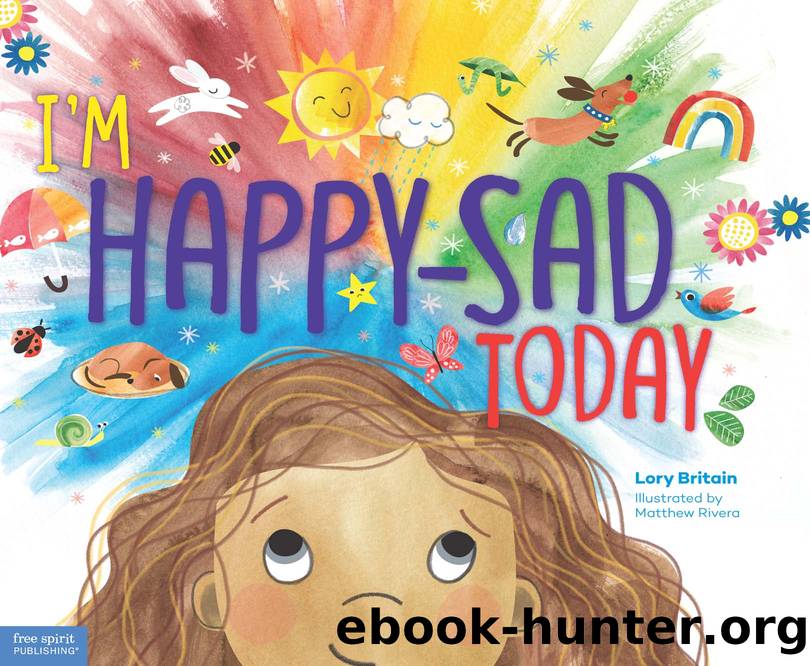
Author:Lory Britain, Ph.D.
Language: eng
Format: epub
Publisher: Free Spirit
Published: 2020-01-27T12:00:00+00:00
Plan Ahead
Planning ahead can be an important part of helping children reach
deeper to share about all their feelings. The following two ideas give
you ways to set the stage for these discussions.
â¢
In strategic areas where children will see them often, place
feeling charts and pictures of children engaged in activities.
Effective spots to choose could include near a classroom door,
near a childâs bed, or near an eating area. Regularly invite and
encourage children to select all of their feelings on the feeling
chart. Or guide children to look at the pictures and discuss how
the children in the pictures might be feeling. Remember to select
pictures and drawings that are understandable to children and
represent all types of diversity (including gender, ethnicity, body
types, and physical abilities).
â¢
Always have a range of age-appropriate and diverse books easily
accessible to children, and be open to using them as jumping-off
points for conversation. Remember that books about complex
emotions do not have to be limited to books that specifically
discuss or focus on emotions. Books conveying childhood
experiences and events in their lives often elicit comments and
discussions about multiple feelings. Some of the most poignant
stories are those that resonate with childrenâs emotions around
a singular childhood circumstance, such as going to bed, los-
ing a pet, going to the doctor, or having a new friend. Also have
books that address delicate subjects, such as divorce or domestic
violence, readily available for adults to select and read privately
with an individual child.
Incorporate Sharing Feelings into Problem-Solving
When problem-solving with a child or group of children, help them
express and represent all their feelings during the problem-solving
process. Often sharing feelings is the first step before generating pos-
sible solutions to a problem. Remember that following through after
implementing a solution could involve sharing about feelings again.
For example, after children choose and implement a solution to a
game-sharing problem and play together, facilitate a follow-up discus-
sion for children to share their feelings about the results.
Share These Concepts with Caring Adults in Childrenâs Lives
Support consistency in childrenâs lives by sharing the ideas in this
book with classroom helpers, co-teachers, volunteers, family mem-
bers, and other caring adults. Whether in a classroom or home, consis-
tency supports childrenâs emotional development.
More Ideas for Activities and Discussion
All these activities draw on ideas in Iâm Happy-Sad Today but some
relate directly to moments in the story. In those cases, youâll see page
numbers referencing the relevant spot in the book.
Telling a Caring Adult (page 23)
Encourage children to tell adults about their feelings, and discuss
ideas for who they might go to when they need or want to talk. If
you are one of the adults children come to, remember that listening
to a child means more than hearing his or her words. Put your body
at the childâs level and remember that eye contact and
other body language convey your emotional pres-
ence. And being present for a child doesnât always
involve words. Sometimes
offering a lap or hug is
just what is needed to
help a child begin to
sort out feelings.
32
Download
This site does not store any files on its server. We only index and link to content provided by other sites. Please contact the content providers to delete copyright contents if any and email us, we'll remove relevant links or contents immediately.
| Boys & Men | Bullies |
| Emotions & Feelings | First Day of School |
| Friendship | Girls & Women |
| Manners | Multiculturalism |
| Peer Pressure | School |
| Self-Esteem & Self-Respect | Social Skills |
| Special Needs | Tolerance |
Call me by your name by Andre Aciman(4694)
Rowling, J.K - Harry Potter 02 - Harry Potter and the Chamber of Secrets by Rowling J K(3321)
Paardenranch heartland - vol vertrouwen by Lauren Brooke(3164)
Harry Potter and the Chamber of Secrets (Book 2) by J.K. Rowling(2828)
The Kiss of Deception by Mary E. Pearson(2791)
Day by Elie Wiesel(2788)
Harry Potter and the Goblet of Fire (Book 4) by J.K. Rowling(2770)
A Thousand Splendid Suns by Khaled Hosseini(2720)
Holes by Louis Sachar(2691)
How to Make a Wish by Ashley Herring Blake(2592)
Just Listen by Sarah Dessen(2581)
I've Got Your Number by Sophie Kinsella(2566)
Bossypants by Tina Fey(2538)
Holding Up the Universe by Jennifer Niven(2512)
Talking as Fast as I Can by Lauren Graham(2452)
Confessions of a Shopaholic by Sophie Kinsella(2379)
The Body Keeps the Score by Bessel van der Kolk MD(2224)
Call Me by Your Name: A Novel by André Aciman(2219)
No Time to Say Goodbye(2123)
